
Seven non negotiable outcomes CIOs and deal leaders in private equity, private credit, and M&A advisory should expect from an AI powered CRM operating model.
Most firms can say, “We have a CRM.” Very few can say, “Our CRM is a real edge in finding and winning the right deals.”
In the alternative assets and M&A advisory world, a system that only records activity is dead weight. In 2026, your CRM should behave like an AI powered operating model. If it doesn’t deliver the seven outcomes below, it’s time to rethink it.
1. It doesn’t capture 90%+ of your interactions automatically
The real story of a deal lives in emails, meetings, decks, and one off notes. If your CRM still depends on people manually logging all of that, it will always be incomplete.
You should expect automatic capture of Outlook emails and calendar events, synced meetings and calls, and AI generated summaries attached to the right companies, contacts, deals, and mandates. If partners and MDs still copy paste notes or keep their own spreadsheets, your CRM has already failed the “single source of truth” test.
2. It doesn’t turn data into sourcing and risk signals
Static company records and pipeline stages are not enough. An AI driven CRM should continuously scan for change: funding, recapitalizations, downgrades, leadership moves, hiring patterns, product launches, and regulatory shifts.
Those signals need to be matched to your investment or mandate themes and pushed to the right people as “reasons to call now.” If sourcing or portfolio monitoring still means exporting lists and skimming news manually, you don’t have an engine — just an address book.
3. It doesn’t map who knows whom or suggest warm paths
Your network is your most valuable asset. “Who do we know?” shouldn’t require a whiteboard session.
You should expect your CRM to infer relationship strength from communications and deal history, map connections across founders, CEOs, sponsors, lenders, bankers, corporates, and LPs, and highlight the warmest path into a target or committee. If you’re still relying on memory and ad hoc email searches, your system isn’t supporting your edge.
4. It doesn’t halve your “time to no”
Winning more good deals and mandates also means saying “no” faster to the wrong ones. If analysts spend days summarizing CIMs or decks just so you can decline, that’s capacity you’re wasting.
An AI native CRM should ingest CIMs, lender decks, and management presentations, extract key terms, risks, and KPIs, and generate concise snapshots so decision makers can decide quickly. If you can’t triage opportunities in hours instead of days, your CRM is draining attention from higher conviction work.
5. Pipeline and mandate reviews are still about data hygiene
If pipeline or mandate meetings are mostly about scrolling reports and updating stages, your CRM is not acting like an operating model.
You should expect it to highlight stuck deals and credits, flag aging stages, and suggest next best actions based on your history. Leaders should leave with sharper priorities, not just cleaner data. If that’s not happening, the system is under delivering.
6. It can’t show how proprietary and repeatable your flow really is
Everyone claims proprietary origination. Very few can prove it with data.
A modern CRM should capture source and channel consistently, tie opportunities to themes and relationships, and report the mix of proprietary, semi proprietary, and fully competitive flow in each business line. If you can’t answer “How differentiated is our pipeline this year?” from your system, you’re flying blind with LPs and clients.
7. It doesn’t live where dealmakers actually work
Even the best AI is useless if partners, PMs, and MDs never see it. Your CRM needs to show up in Outlook, Salesforce, Teams/Slack, and mobile — surfacing context and signals in the tools people already use, not demanding yet another portal.
If your system only exists in a separate tab that people open grudgingly, true adoption will never happen and your AI story will stay theoretical.
In 2026, the real question isn’t “Which CRM has the most features?” It’s: “Is our CRM behaving like an AI powered operating model for private markets — or is it just a database with a modern UI?”
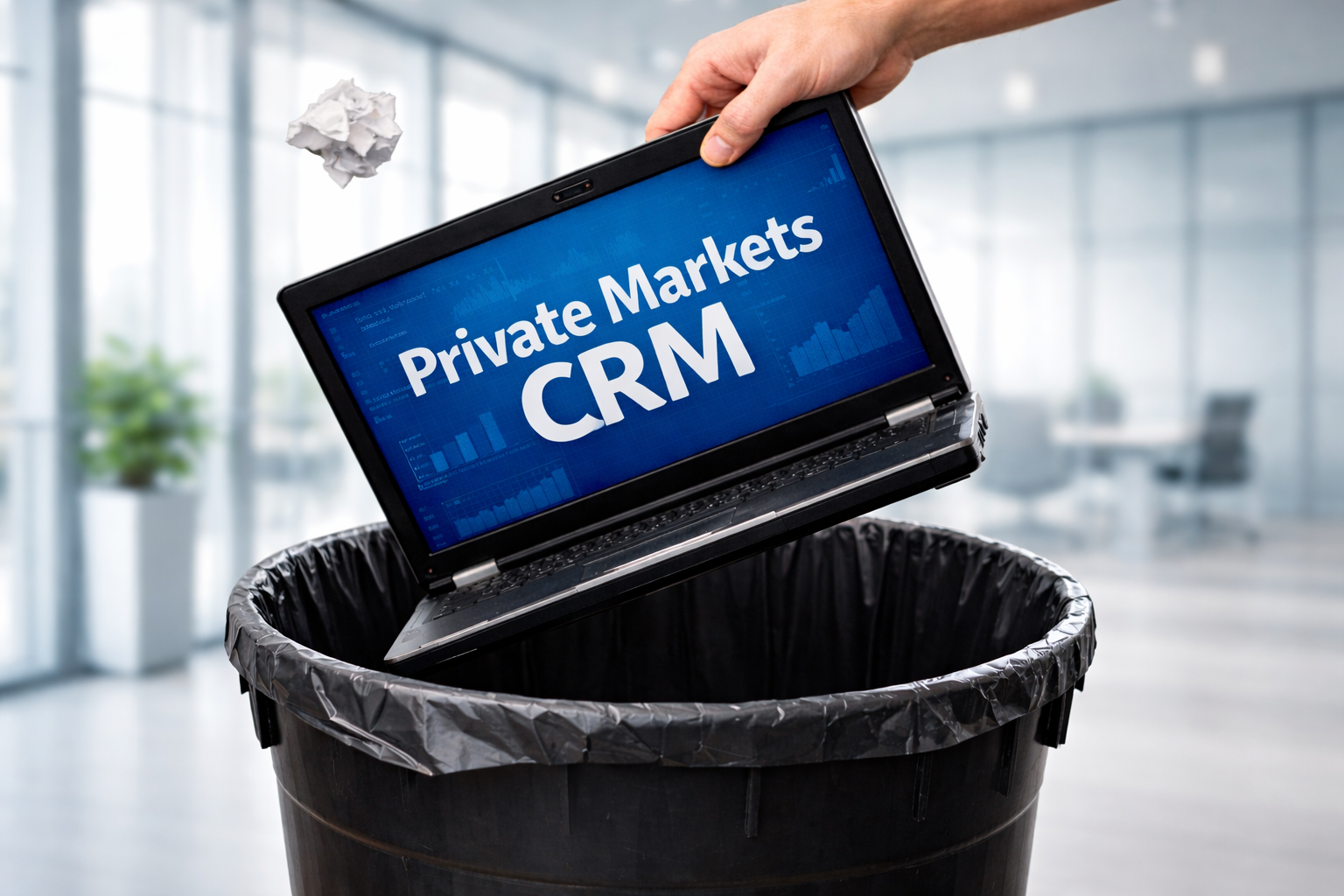
If it fails these seven tests, it’s time to trash it and replace it with something that actually works alongside your teams every day.
That’s the standard we’ve used to design Navatar’s AI powered CRM operating model on Salesforce for private equity, private credit, real assets, and M&A advisory: auto capture of interactions, live signals, relationship intelligence, faster “no,” smarter reviews, clear origination visibility, and workflows embedded where dealmakers already work. If you want to see what passing all seven tests looks like against your own pipeline, we can walk through it in a 30 minute session.